
Running a One-Person Business? Here's How to Track Time Like a Company
Companies with five employees use the same basic time infrastructure as companies with 500. Solo freelancers use whatever they managed to set up. That gap is worth closing.
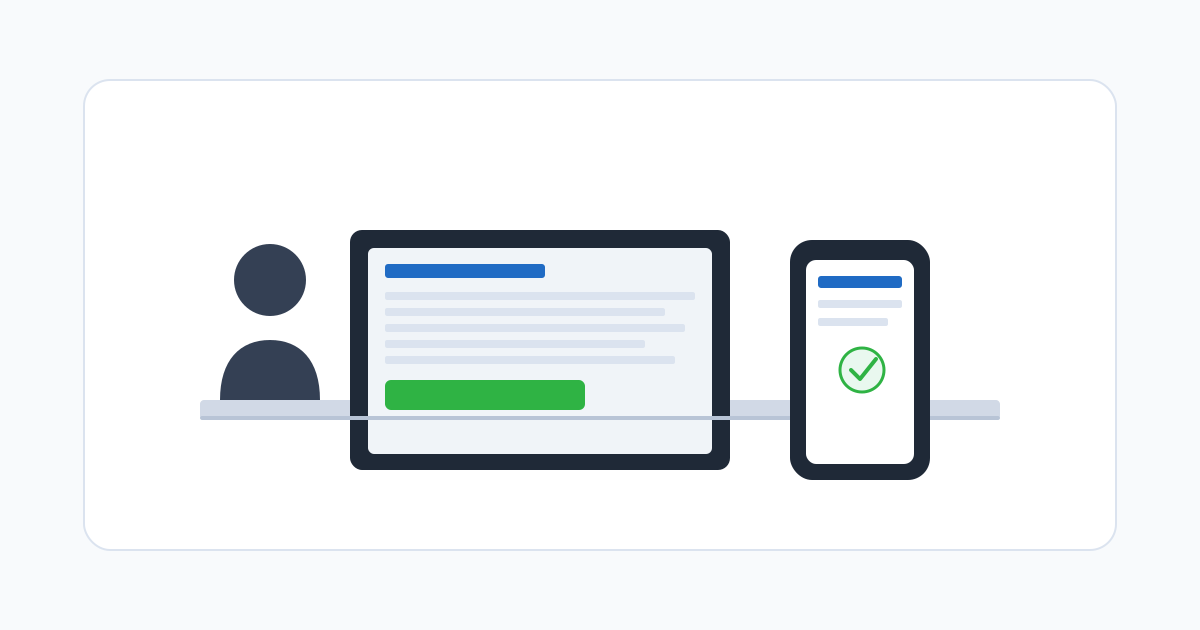
Why companies track time — and why solo workers need the same thing
A company with ten employees doesn’t use time tracking because it distrusts its staff. It uses time tracking because everyone — the employees, the managers, the accountants, the auditors — needs a shared record of who worked when. Without it, payroll becomes a guessing game, invoice disputes become he-said/she-said, and tax time becomes a reconstruction project.
Solo freelancers have the same underlying needs and none of the inherited infrastructure. When you work for yourself, there’s no payroll system, no HR department, and no one else building the record on your behalf. Whatever time tracking happens is whatever you personally set up.
Most solo workers set up very little. A spreadsheet, maybe. A notes app. Sometimes nothing at all. This feels fine right up until it isn’t: an invoice gets questioned, a client delays payment pending documentation, or it’s April and you’re trying to reconstruct six months of billable hours for a tax filing.
The real cost of informal time tracking when you’re self-employed
The direct cost is easy to describe — disputes you lose, invoices you can’t justify, hours you forget to log. But the less visible cost is what happens to your pricing confidence over time.
When you don’t have clear records, you start to doubt your own numbers. You round down on borderline projects to avoid a conversation you’re not prepared to have. You accept a client’s pushback even when you know your hours were accurate, because you can’t prove it. The value of your work leaks out of the gaps in your record-keeping.
A freelancer who can pull up a timestamped log for any project, at any time, negotiates differently. Not aggressively — just from a factual position. That shift in confidence is worth more than most productivity tools.
What a company-grade time record looks like for one person
The company version isn’t more complex than what a solo worker needs. It’s just more consistent. A company-grade record has actual session start and end times — not daily totals, but the specific window when work happened. It ties each entry to a device. It closes each billing period formally before invoices go out, so the record doesn’t get retroactively adjusted after a dispute starts.
For a solo worker, this translates to: clock in when you start. Clock out when you stop. Add a one-line note if the session is part of a project the client might want visibility on. Close the month when you invoice.
That’s it. No team, no manager approval, no complex configuration.
The discipline matters more than the tool. A good tool just removes the friction from maintaining the discipline.
The daily habit that builds a two-year record without thinking about it
The easiest system is the one you’ll actually use every day. The clock-in should take ten seconds — the same reflex as opening your email or your project board. The clock-out should happen when you close the laptop.
Don’t round the sessions. If you worked 1 hour 22 minutes, log 1 hour 22 minutes. Real sessions are irregular, and irregular durations are more credible than tidy ones. Don’t reconstruct. If you forgot to clock in, add a note explaining the gap rather than backdating a start time you can’t verify — an annotated correction looks like an honest record; a backdated entry looks like something else.
The end-of-month close takes fifteen minutes. You review the open sessions, confirm the total matches what you’re invoicing, close the period, and export. The record is now locked. Nothing about it will change whether the client pays immediately or in four months when they’ve lost the original invoice and want to re-verify the hours.
The compounding value of a consistent record
A one-month time record is billing documentation. A twelve-month record is business history. It shows your working patterns, your project load, your capacity, and your billing consistency over time.
This matters in ways that aren’t immediately obvious. A lender who asks for proof of self-employment income needs more than bank statements — they want to see consistent activity. An accountant preparing your tax return works faster when the record is clean. A client who’s asking whether you have capacity for a new project can see your current load.
The record you build month by month, while you’re just trying to get invoices paid, is the same record that answers all of those questions years later.
HRaaS has a free tier built for exactly this: clock in from your phone, close the period at month end, export a clean report. No team required.
Related posts
Getting a Business Loan as a Freelancer: Why Time Records Matter More Than You Think
A lender reviewing a freelancer's income doesn't see a salary. They see irregular deposits and gaps. Time records are one of the few things that turn that picture into a readable business history.
Proving Freelance Work History for Visa Applications: What Actually Counts as Evidence
An immigration officer reviewing your self-employment history isn't interested in your portfolio. They want documented evidence that your work was continuous, substantive, and on the record. Most freelancers' documentation doesn't survive that standard.
Working in a Foreign Country as a Contractor: What Records You Must Keep
Tax authorities in two countries may both have a claim on your income, depending on where you worked and for how long. What you can prove about your location and working time shapes how those claims get resolved.