
When the App Goes Down: Your Time Records Shouldn't Go With It
Most time tracking tools store your data in their cloud. When they have an outage, get acquired, or wind down, that's years of work history in someone else's control. Here's the position worth being in instead.
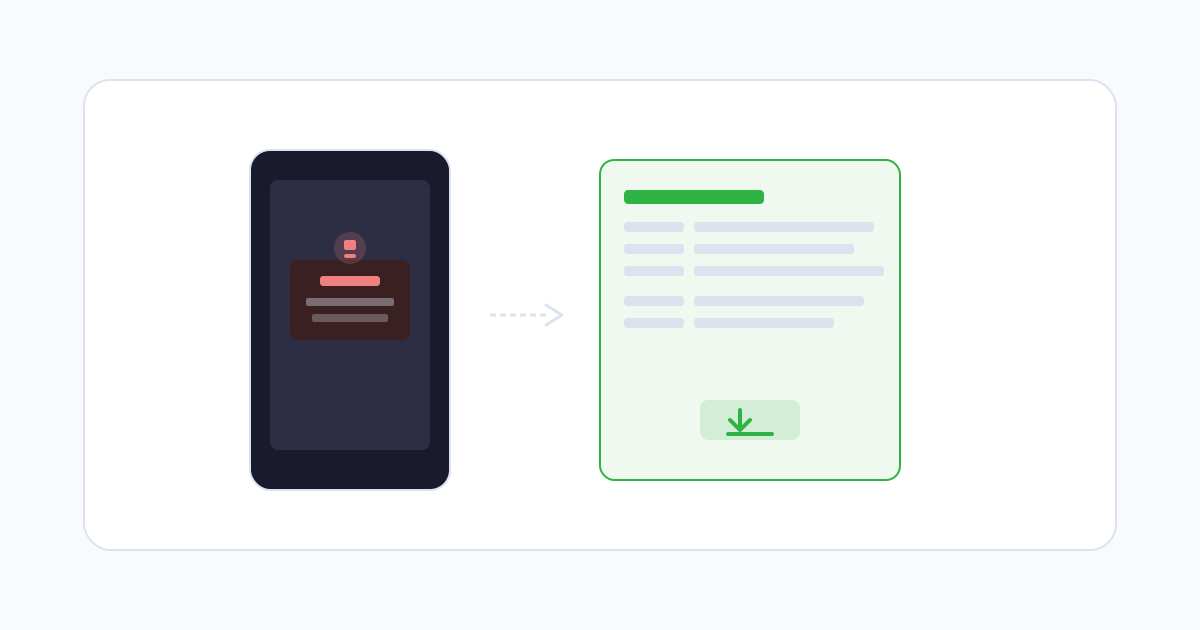
The outage that turns into a billing problem
You go to pull your time log before sending the invoice. The app won’t load. Support says they’re investigating an incident and it should be resolved shortly. “Shortly” turns into three days. The client is waiting. The invoice is due.
In the best version, you send the invoice late, the app comes back, and everything continues. In a worse version, the outage happens during a disputed billing cycle — the specific month a client is questioning — and you can’t access your records during the exact window you need them.
The app coming back solves the immediate problem. It doesn’t solve the fact that your billing documentation was inaccessible at a moment when you needed it available on demand.
SaaS dependency risk and your work history
Outages are the visible version of a more general problem: your time records, if they exist only in a third-party SaaS tool, are subject to that tool’s health, decisions, and business trajectory.
Tools shut down. Startups close. Companies get acquired and the product gets sunset. Even mature tools have had migrations where users lost historical data, or pricing changes that effectively made old records inaccessible to free-tier users. If your records live only in a tool and the tool changes, your records change with it.
This doesn’t mean you shouldn’t use cloud-based time tracking. It means you shouldn’t use it as your only copy.
The acquisitions and shutdowns that affect record continuity
You don’t have to speculate. There’s a documented history of time tracking tools being acquired, merged, or wound down in ways that affected user data access. Import restrictions get added. Export formats change. Historical data gets migrated to the new owner’s platform with different access tiers and different retention policies.
Every time a tool you use changes hands, there’s a window where the question “can I still get my data?” has an unclear answer. The users who have a clean answer to that question are the ones who have their own copies.
The export habit is simple: at the end of every month, export your closed period. A PDF or CSV that lives in your own storage. It takes five minutes. Over two years, it builds a complete record that’s independent of whatever happens to the tool that generated it.
What “accessible” means when it actually matters
The moments when you need your time records aren’t predictable. A tax audit. A contract dispute that surfaces eight months after the project closed. A new client asking for a sample of your work documentation before they sign. In every case, the record you need is from a period that’s already done.
The question at that moment is whether the record is in your hands or in someone else’s. If it’s yours — a folder of monthly exports, your own account with portable data, a spreadsheet you maintain alongside your primary tool — you can produce it immediately, in whatever format the situation requires. If it’s locked inside a tool you no longer subscribe to, or a platform that changed its access model, the answer is more complicated than it should be.
The record that’s under your control is the record you can actually use.
HRaaS stores your records in your account with full export access from day one. Monthly exports take one click and the file is yours.
Related posts

IT Consultants: How to Bill Multi-Client Days Without Disputes
Splitting a day across three clients is normal. Explaining how you got to the invoice total on each one, without a session-level log, is a problem waiting to happen.
What Happens When a Platform Disputes Your Hours
If a dispute goes to a platform's resolution center, you and the platform are not in a neutral conversation. They have the data. You have whatever you kept on your own.
Digital Time Records: The Quiet Protection Every Worker Deserves
Most months you won't think about your time records at all. The month you need them, you'll be very glad they're there — and very sorry if they aren't.