
Attendance compliance: record retention, audit readiness, and employee transparency
What attendance records you should keep, how long to keep them, who can see them, and how to stay ready for an audit without building a surveillance archive.
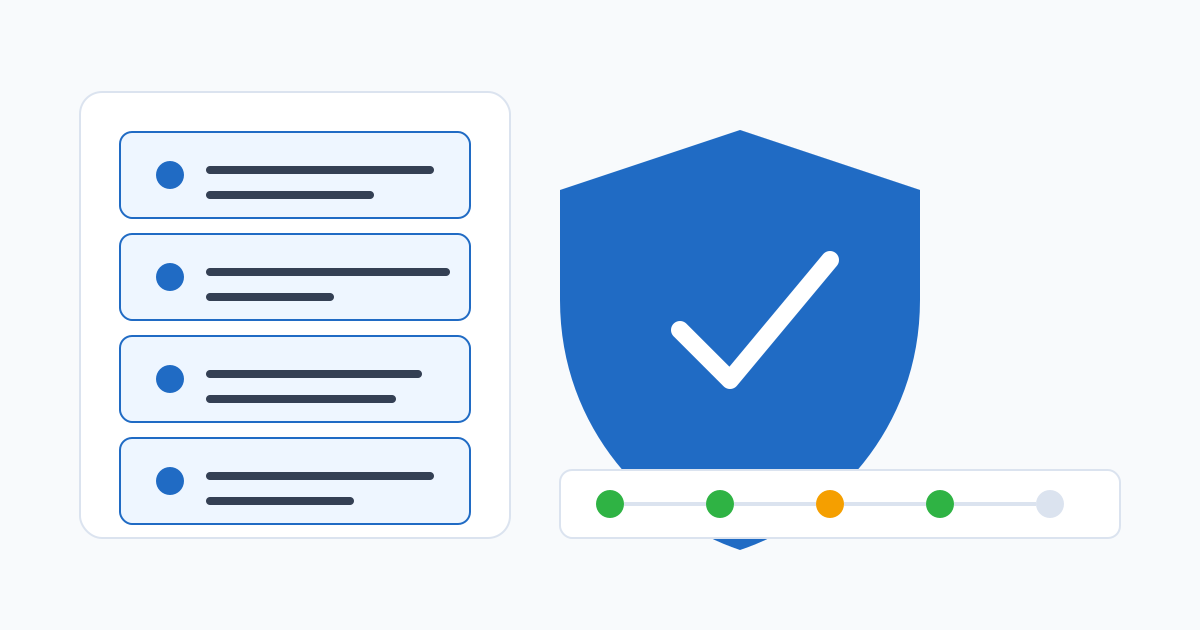
Compliance is not the goal — defensible records are
Attendance compliance gets framed as a list of regulations to satisfy. That framing is not wrong, but it misses the point. The thing you are actually building is a set of records you could defend in front of a payroll auditor, a wage-and-hour inspector, a labour court, or an employee asking why their pay is what it is. The regulations describe the floor. The defensible record is the ceiling.
This post is general guidance, not legal advice. Specific retention periods and required fields vary by country, state, and industry. If you operate in more than one jurisdiction, get a qualified employment lawyer to map the rules to your business.
What an attendance record should actually contain
Most regulators want some version of the same thing: who worked, when, how much, where (if relevant), how rest periods were managed, and what was paid for it. Translated into attendance records, you should be able to produce, for every employee and pay period:
- Identity of the employee (employee ID and the person they are).
- Scheduled hours for each day in the period.
- Actual clock-in and clock-out times, with source (mobile, web, terminal).
- Any breaks, with start and end times.
- Location context when location was used to validate the punch.
- Each correction made to the original record, with timestamp, author, and reason.
- Manager approval of the final timesheet, with timestamp.
- The hours that were exported to payroll.
If a regulator asks how a specific Tuesday afternoon went, you should be able to answer with the original punches, the corrections, the approvals, and the export — not from memory.
Retention: keep enough, not everything
Retention periods vary by jurisdiction. Common reference points in many systems:
- Time records and wage information: often 3 to 7 years.
- Records used to compute pay (schedules, rates, premiums): similar windows.
- Records related to claims or disputes: retained as long as the matter is live, plus the statute of limitations.
A few principles travel well:
- Default long, not short. It is much harder to defend a missing record than an extra one.
- Same retention across linked records. Punches, corrections, approvals, and payroll exports should age together. Keeping the punch but discarding the correction reason is worse than keeping nothing.
- Have a documented schedule. “We keep records as long as the system happens to” is not a retention policy. Write the periods down.
- Decide before the record is created. Going back to delete after the fact is what produces the awkward partial archives.
Audit readiness is a feature of your workflow
The teams that breeze through audits do not scramble to assemble records at the last minute. Their day-to-day workflow already produces audit-ready data:
- Original punches are immutable; corrections are logged as separate events.
- Approvals are explicit and timestamped.
- Manager edits are tied to a reason.
- Exports to payroll are reproducible from the approved state.
- Access is limited to people with a real reason to see the data.
If your normal pay-period close already produces these artefacts, an audit becomes a query, not a project. If it does not, audit readiness becomes a quarterly fire drill.
Employee transparency belongs in the policy
The strongest attendance compliance posture is one employees can see. A short, public-facing description of what is recorded, why, and how to request a correction does several useful things at once:
- It satisfies common transparency requirements in privacy-aware jurisdictions.
- It reduces support questions about “why is the system tracking me?”.
- It gives managers a shared reference when handling disputes.
- It makes a wage-and-hour conversation evidence-based rather than emotional.
Cover at least: what attendance data is collected, when location is used (if at all), who can see the record, how long it is kept, how an employee can request a correction, and how an employee can request a copy of their own data. Keep it plain language. Long privacy notices that read like legal armour usually produce less trust, not more.
Access controls are a compliance lever
Who can see attendance records is part of the compliance picture, not a separate IT concern. A reasonable baseline:
- Employees can see their own complete record.
- Direct managers see their team only.
- Regional managers see their region, including any cross-team rollups they actually need.
- HR or payroll see what the role requires.
- Platform administrators have audited access for legitimate operational reasons only.
Over-broad access — where every manager can see every employee’s history — is a problem even if the data is technically correct. It increases the blast radius of any leak, undermines employee trust, and makes data-subject access requests harder to scope.
Corrections must be additive, not destructive
A common compliance failure is silent editing: a manager changes a punch from 9:15 to 9:00, the record now shows 9:00, and there is no evidence the change ever happened. From a regulator’s perspective, that is the same as having no record. From an employee’s perspective, it is worse.
Corrections should be additive: the original punch stays, the correction is recorded as a separate event with author, timestamp, and reason, and the timesheet presents both. The final approved value is what payroll uses. The history is what an audit reads.
Handle finalisation and reopening carefully
Once a pay period is closed, the records inside it should be considered finalised. Reopening for a real correction is normal — every operations team does it — but it must not erase what was finalised. A clean approach is to supersede the old record with a new version, preserving who finalised it the first time and who reopened it. Anyone looking at the history can see exactly what changed and why.
A finalised period that can be silently overwritten is not finalised; it is a draft.
A compliance checklist for the next pay period
Before closing the next period, check:
- Every scheduled employee has complete punches or approved corrections.
- All corrections include an author, timestamp, and reason.
- Manager approvals are recorded with timestamps.
- Location data was collected only where the policy says it would be.
- Access to the records is scoped to the right people.
- Retention is on a documented schedule.
- The employee-facing description of how attendance works still matches reality.
You will not run this checklist forever. After a few cycles it becomes the workflow, and the records take care of themselves.
Related reading
Related posts
Monthly attendance close: pipeline, finalization, and reopening safely
How to run a monthly attendance close that locks the record without making corrections impossible — including the right way to reopen a finalized month.
Attendance software vs time clock apps: how to choose for a growing team
The two categories overlap, but they solve different problems. A practical breakdown of when a time clock app is enough and when you need full attendance software.
Buddy punching prevention: device risk without crossing the line
How to reduce buddy punching with proportionate device checks, location signals, and review patterns — without turning attendance into surveillance.