
Attendance exceptions playbook: missed punches, late arrivals, and corrections
How to triage and resolve the most common attendance exceptions before they turn into payroll disputes.
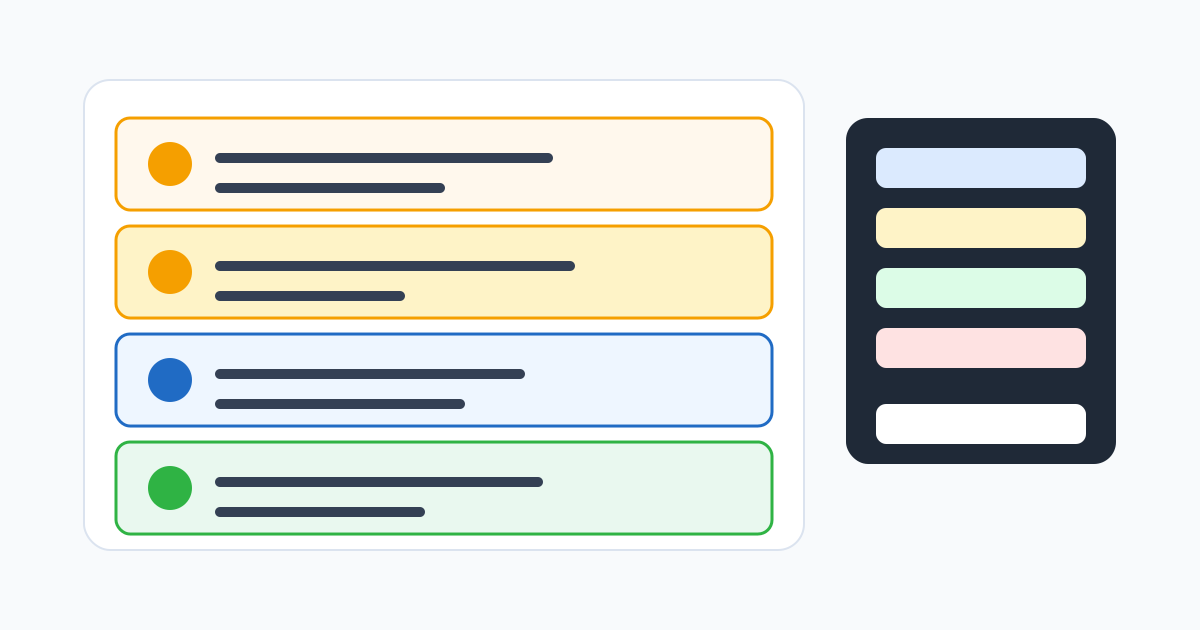
Treat exceptions as the real workflow, not the edge case
Every attendance system collects exceptions: missed punches, late arrivals, early departures, location flags, overtime spikes, absences without notice. They are not unusual. They are the daily work of running attendance. The question is not whether you have them — it is whether you have a clear process for resolving them before payroll closes.
A short, repeatable triage playbook saves more hours than any new feature. It also keeps the relationship between managers and employees fair, because the same kind of exception gets handled the same way every time.
Sort exceptions by what the system can prove
Before deciding what to do, separate exceptions by what the system can actually verify:
- Mechanical exceptions. Missed clock-out, phone offline, app crashed, sync delay. The work probably happened; the record is incomplete.
- Schedule exceptions. Late arrival, early departure, absence, schedule mismatch. The record exists; the question is whether it matches the agreement.
- Location exceptions. Off-site punch, geofence drift, wrong Wi-Fi. The record exists; the question is whether the location is acceptable.
- Policy exceptions. Unapproved overtime, working off the clock, repeated short shifts. The record may be correct; the question is whether the pattern is allowed.
Different categories need different responses. A missed clock-out is usually a quick correction. A repeated unapproved overtime pattern is a conversation, not a single-shift decision.
Missed punches: correct fast, but require structure
Missed punches are the most common exception. They are also the easiest to resolve — provided employees can submit a structured correction request that includes the date, the corrected time, and a short reason.
Avoid the trap of fixing them in chat. A message that says “I forgot to clock out yesterday, can you fix it?” is not a record. A correction request linked to the original punch, with a manager approval, is. The first leaves payroll guessing. The second leaves an audit trail.
If correction requests pile up from the same employee, that is a coaching signal, not a paperwork problem. The system can show the trend; the manager handles the conversation.
Late arrivals and early departures: define before you enforce
A late-arrival exception is only meaningful if “on time” is defined. Your attendance policy should say when employees are expected to be working, whether a grace period applies, and how repeat patterns are handled. Without that, every exception turns into a one-off negotiation.
When the rule exists, the workflow is simple: the system flags the punch, the manager confirms whether the lateness was approved or not, and the timesheet preserves the verdict. Repeat patterns roll up into a coaching conversation rather than a payroll fight.
Location exceptions: flag, do not block
Most teams should treat off-site punches as flags rather than hard blocks. Blocking forces an honest employee who really did work to do nothing — or to find a workaround. Flagging records the punch and asks a manager to confirm the context.
Common location exception patterns:
- GPS drift. A one-off punch slightly outside the geofence at a known site. Usually approved with a short note.
- Wrong location assignment. The employee was sent to another branch and the schedule was not updated. Approve the punch, fix the assignment.
- Off-site recurring pattern. Same employee, same off-site location, multiple shifts. This deserves a conversation, not a silent approval.
A flag plus a manager note is a much cleaner record than a refusal that triggers a manual workaround.
Absences and no-call no-show: separate notice from cause
Absence handling has two questions: did the employee give notice, and was the reason allowed? Both belong in the record, but they should not be conflated. A late but honest notice is different from a no-call no-show. A genuine emergency is different from a pattern of unplanned absences.
The attendance system should let managers tag the absence with the reason and the notice quality. Payroll and HR can then make decisions based on the pattern over time, not the memory of one bad week.
Overtime: review during the period, not after
Overtime is the exception that costs real money. Catching it on payroll day is too late — by then, the only options are paying it or arguing about it. Review overtime mid-period, while you still have time to adjust schedules.
If overtime requires manager approval, the approval should be visible on the timesheet before payroll runs. If it is calculated automatically by jurisdiction, managers should still see the operational reason: planned coverage, peak demand, missed handoff, schedule error. Each one leads to a different fix.
A short triage rubric for managers
When an exception lands in the queue, ask in this order:
- Is the record incomplete or wrong? Fix it with a correction.
- Was the deviation approved in advance? Confirm and move on.
- Is there a one-off explanation? Capture the note and approve.
- Is this a recurring pattern? Approve the shift, schedule a conversation.
- Is this a policy breach? Document, escalate per the policy.
The rubric is not a rule book. It is a way to keep exceptions from becoming a guessing game.
Close every exception before payroll
The end state is simple: at the cutoff time, every exception in the period is either resolved, approved, or explicitly deferred with a reason. Anything still open is a known risk, not a hidden one.
When the workflow is in place, exceptions stop feeling like a problem and start feeling like the system working. The system surfaces what needs attention. People decide. The record preserves the decision.
Related reading
Related posts
Monthly attendance close: pipeline, finalization, and reopening safely
How to run a monthly attendance close that locks the record without making corrections impossible — including the right way to reopen a finalized month.
Attendance software vs time clock apps: how to choose for a growing team
The two categories overlap, but they solve different problems. A practical breakdown of when a time clock app is enough and when you need full attendance software.
Buddy punching prevention: device risk without crossing the line
How to reduce buddy punching with proportionate device checks, location signals, and review patterns — without turning attendance into surveillance.