
Why Freelancers Undercharge (And What Your Time Log Reveals)
The rate felt reasonable when you set it. The post-project math told a different story. Here's why the gap between your rate and your real earnings has a specific, fixable cause.
The rate isn’t the problem
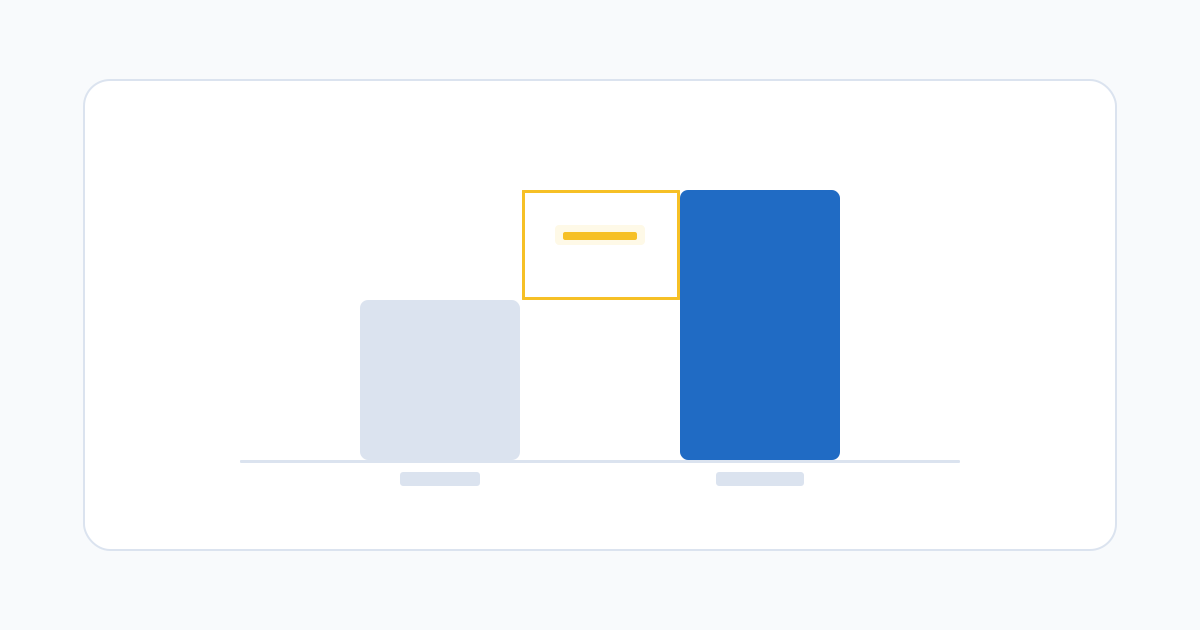
Most freelancers who undercharge don’t set a bad rate. They set a reasonable one based on the scope they understood at the start of the project. The problem is that the scope they end up delivering is rarely the scope they priced.
Scope doesn’t usually blow up all at once. It expands incrementally — a revision round that wasn’t in the brief, an extra meeting to realign on direction, a research phase that turned out to be longer than expected. None of these feel like billing moments. Each one feels like the kind of thing you absorb because the relationship matters, or because the total isn’t yet egregious, or because you’re not sure how to bring it up.
By the end of the project, you’ve delivered something meaningfully larger than what you quoted, and done it at the rate you quoted for the smaller version.
Why this is invisible without a record
If you’re not logging time as you work, you genuinely don’t know how many hours a project took. You know roughly. You remember the big sessions and the hard parts. But the total you put on the invoice is almost certainly an estimate, even if it feels like a calculation.
This matters because undercharging doesn’t feel like a decision — it feels like a fact. You worked X hours, you charge for X hours. But if X was never measured, it’s a reconstruction. And reconstructions are systematically low, because you remember the work you remember and not the work that happened quietly in between.
The post-project time log tells a different story. When you close a project and look at the actual session-by-session record, the gap between what you estimated and what you logged is often 20–40%. Not because you’re incompetent at scoping — because every project has invisible time. Admin. Rework. Communication overhead. Waiting for feedback, then re-reading the brief when it finally arrives.
That invisible time is still your time. You’re just not billing it.
The scope-creep pattern that happens on almost every project
There’s a specific dynamic that causes most of the undercharging: the client makes a small request, you do the work without flagging it as out of scope because it feels small, and then it happens again. Three or four rounds of this and you’ve added 15 hours to a project for free.
This isn’t bad faith from the client. They often don’t realize the requests add up. They asked for small things and you delivered small things. The accumulation is invisible to them too — unless someone shows it to them.
A time log makes this visible in both directions. You can see it building in real time, which means you can flag it before it becomes a post-project problem. And you can show it to a client afterward if needed — not as an accusation, but as an explanation. “Here’s where the project expanded beyond the original scope. This is why the hours are higher than we initially discussed.”
That conversation goes better when you’re showing a record rather than narrating a memory.
What happens when you start tracking
The first month of real-time logging is often uncomfortable, because you see exactly what the projects actually cost you. Projects you thought of as quick take three times as long as you estimated. Clients who feel low-maintenance turn out to consume significant coordination time.
This is not a reason to raise your rates immediately. It’s a reason to price future projects with accurate information instead of optimistic estimates. And it’s a reason to have a conversation with yourself about which engagements are actually worth what they feel like they’re worth.
Freelancers who track time consistently for three to six months almost always discover that one or two project types are significantly more expensive to deliver than they appear. That discovery is worth hundreds or thousands of euros in annual revenue, depending on how much of that work you take.
You can’t renegotiate a rate you never measured.
HRaaS logs real session times automatically. Clock in at the start of a project, clock out when you stop. At the end, the total is actual — not reconstructed.
Related posts
What to Do When Your Hours Don't Match Your Paycheck
You logged 43 hours. The payment covers 40. Nobody says anything until you do. Here's how to identify the gap, document it cleanly, and have the conversation without it turning into a dispute.

Your Work Hours Are Your Property — Here's How to Own Them
When a long-term client engagement ends, your work product usually leaves with you. Your time records might not — especially if they live in the client's system.
Running a One-Person Business? Here's How to Track Time Like a Company
Companies with five employees use the same basic time infrastructure as companies with 500. Solo freelancers use whatever they managed to set up. That gap is worth closing.