
Attendance analytics: the KPIs that actually change decisions
A short list of attendance KPIs worth measuring, what each one signals, and how to avoid dashboards that look impressive but go unread.
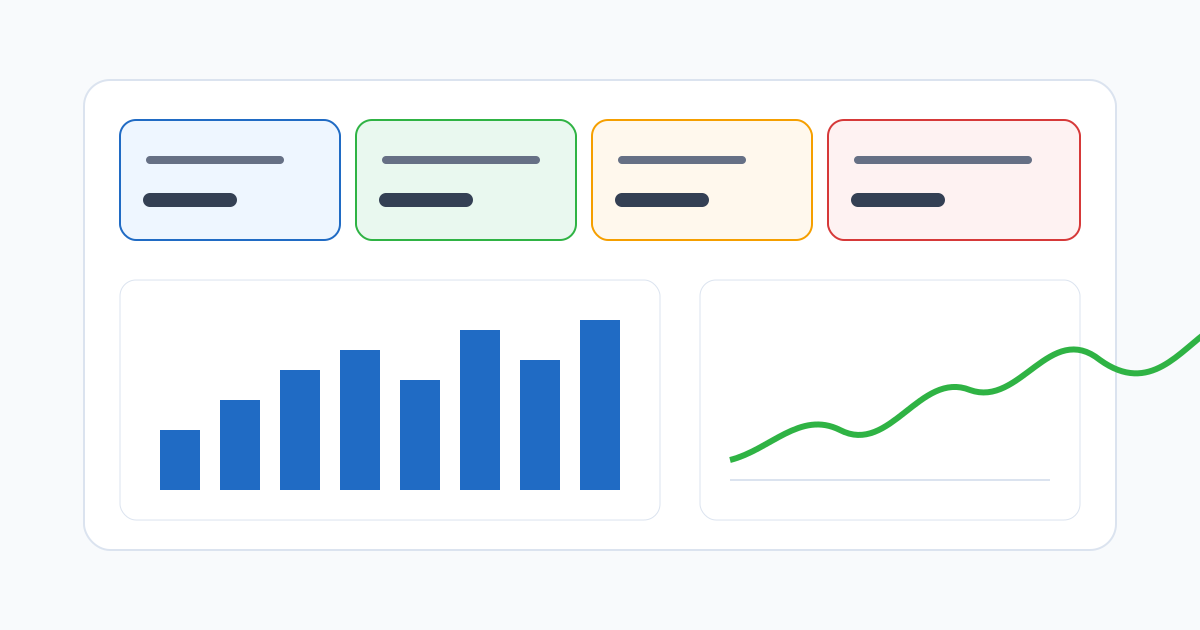
A useful KPI changes a decision
Attendance dashboards are easy to build and easy to ignore. The reason most go unread is not that the numbers are wrong — it is that no one is sure what to do about them. A useful KPI is one that, when it moves, changes a specific decision: a schedule, a conversation, a hiring plan, a policy. Anything else is decoration.
This post lists the small set of attendance KPIs that consistently earn their place, what each one signals, and the common ways they mislead.
Hours worked vs hours scheduled
The single most useful baseline KPI is the gap between scheduled hours and actual approved hours. When the gap is small and stable, attendance is healthy. When the gap widens, something has changed — under-staffing, overtime drift, unauthorised early departures, or a schedule that no longer reflects how the team actually works.
The KPI is most useful per team or per location, not as a single company number. Two locations averaging out can hide a chronic over-run at one and a chronic shortfall at the other.
Lateness rate
Lateness rate is the percentage of shifts that started after the scheduled start time. Define “late” clearly — including any grace period from your attendance policy — and track the rate per team and per individual.
What to do with it:
- A high team rate signals a scheduling or commute problem more often than a discipline problem. Ask whether shift starts align with realistic arrival windows.
- A high individual rate is a manager conversation, not a payroll one. The system flags the pattern; the conversation handles the person.
- A spike that affects everyone usually points to an external cause (traffic, weather, transit) or a process change (new entry procedure, badge issues).
What it does not tell you: whether the work that followed was good. Lateness is a process signal, not a performance signal.
Absenteeism rate
Absenteeism is the percentage of scheduled hours that were not worked because of unplanned absence. Planned leave (approved vacation, scheduled sick days) does not count; the point is the absences the schedule did not expect.
Useful breakdowns:
- By team and location.
- By day of week (Monday/Friday spikes are common and not always coincidental).
- By tenure (new joiners often have a different pattern than long-tenured staff).
- By notice given (no-call no-show vs late notice vs same-day notice).
A 2% absenteeism rate that is mostly same-day notice with explanations is operationally very different from 2% mostly no-call no-show. The headline number is the same; the response is not.
Exception rate per shift
The exception rate is the percentage of shifts that produced at least one attendance exception — a missed punch, a late arrival, an off-site location flag, an unapproved overtime block. A healthy operation is not one with zero exceptions; it is one where the exception rate is steady and the resolution time is short.
If the rate climbs, it usually means one of:
- The configuration is wrong (a geofence that is too tight, a schedule that no longer matches reality).
- A workflow changed and the team has not adapted.
- A specific manager has stopped reviewing in time.
The fix is usually configuration or coaching, not more rules.
Time-to-resolve exceptions
This is the average time from when an exception is created to when a manager resolves it. It is one of the strongest predictors of payroll-day pain. A team where 90% of exceptions are resolved within 48 hours runs a clean close. A team where exceptions sit for a week ends up scrambling at cutoff.
Time-to-resolve is also a fairness signal. Slow resolution often means inconsistent decisions — a manager who finally clears the backlog at 9pm on payroll day is not making careful judgement calls about each one.
Overtime concentration
Total overtime is a useful headline. The KPI that actually changes decisions is overtime concentration: what percentage of overtime is being absorbed by the top 10% of employees by overtime hours.
If overtime is broadly distributed, it usually reflects business demand. If it is concentrated on a small group, it usually reflects a coverage gap — that group is plugging a hole that scheduling, recruiting, or cross-training should fill. Concentration is also a burnout signal worth taking seriously.
Approval timeliness
Approval timeliness is the percentage of timesheets approved by the cutoff. It is a managerial KPI, not an employee one. When it is low, payroll either runs with incomplete data or runs late. When it is high, the close is boring — which is the goal.
A simple rule: if approval timeliness is below 90%, the cutoff or the approval workflow is wrong. Either the time managers have to review is too short, or the queue is being routed to the wrong person.
Coverage by location
For multi-location teams, coverage by location compares scheduled headcount against actual on-site headcount through the day. It is more useful than total hours because it answers an operational question: was the shift covered at the right time, not just on average.
Coverage gaps tend to cluster around shift change, breaks, and end-of-day. A heatmap by hour and location often shows patterns the spreadsheet view hides.
Avoiding the dashboard trap
A few principles keep an attendance KPI deck honest:
- One owner per number. If no one is responsible for the rate going up or down, no one will act on it.
- Trends, not snapshots. A single week is noise. A four-week or eight-week trend is signal.
- Per-team breakdowns over company averages. Averages hide the teams that actually need attention.
- Compare against the schedule, not against last week. A 5% increase versus a slow week is not the same as a 5% increase versus the steady baseline.
- Kill numbers no one uses. A dashboard with twelve charts no one reads is worse than three charts that drive decisions.
A short starter set
For most teams, this small set covers the ground:
- Hours worked vs scheduled.
- Lateness rate.
- Absenteeism rate.
- Exception rate per shift.
- Time-to-resolve exceptions.
- Overtime concentration.
- Approval timeliness.
If these are healthy, the operation is healthy. Anything fancier should be added only when it changes a decision the team is actually trying to make.
Related reading
Related posts
Monthly attendance close: pipeline, finalization, and reopening safely
How to run a monthly attendance close that locks the record without making corrections impossible — including the right way to reopen a finalized month.
Attendance software vs time clock apps: how to choose for a growing team
The two categories overlap, but they solve different problems. A practical breakdown of when a time clock app is enough and when you need full attendance software.
Buddy punching prevention: device risk without crossing the line
How to reduce buddy punching with proportionate device checks, location signals, and review patterns — without turning attendance into surveillance.